Case Study
Nexus Mods
Overview
Project: Nexus Mods Redesign
Role: Creative / Content Director, leading research, information architecture and design oversight
Timeline: July 2015 to November 2017
Skills: UX Research, Information Architecture, Heatmap Analysis, Community Engagement, Design Management
The Problem
By 2015, Nexus Mods was the biggest modding platform on the internet, with around eight million members and over a billion downloads. The website, however, hadn't kept pace. It was desktop-only, visually dated, and riddled with UX issues. Navigation was clunky, mod discovery was poor, the upload process was confusing, and mobile users were completely shut out.
My role was to lead the research, define the information architecture, and oversee the redesign by managing the designer through the entire process. I had helped the site informally before joining, and as a daily user myself I already had a head start on understanding where the problems were.
Research
25,000 Survey Responses in One Weekend
We launched a community survey expecting a few thousand responses over a couple of weeks. We got 25,000 in a single weekend. That data became the foundation for every design decision that followed, replacing assumptions with evidence.
Member Interviews
Surveys tell you what. Conversations tell you why. We interviewed casual users, prolific uploaders, and moderators to understand the full spectrum of pain points. Uploaders described getting lost halfway through the mod submission process. Users stumbled across great mods purely by accident. Moderators flagged layout inconsistencies that made their jobs harder than necessary.
Heatmaps and Scroll Maps
We ran heatmap and scroll map analysis across every major page. The results confirmed what the community was telling us: attention was concentrated on the top of pages, and huge amounts of content (new mods, trending files, community news) were buried below the fold where almost nobody ventured.
The 80-Page Site Review
An exhaustive review in InVision documented every page, template, and user flow. It involved hundreds of discussions with staff and mapped how every part of the site connected, because changing one thing inevitably affected five others.
Key Challenges
Hidden Mods
The site heavily favoured established, popular mods. If you'd just uploaded something brilliant and niche, good luck getting noticed. Filtering tools were basic, sorting was limited, and new uploads vanished from view within hours. This wasn't just a UX problem. If talented modders can't get their work seen, they stop uploading, and the platform stagnates.
Readability
Grey text on dark blue backgrounds. It looked atmospheric but was genuinely hard to read, especially for users with visual impairments. Higher-contrast colour combinations became a non-negotiable requirement.
Information Architecture
Content competed for attention with no clear hierarchy. The mod upload process was a multi-step maze. The homepage surfaced the wrong content and buried the good stuff. Mapping the full IA and understanding how every page and feature interconnected was essential before any design work could begin.
The Solution
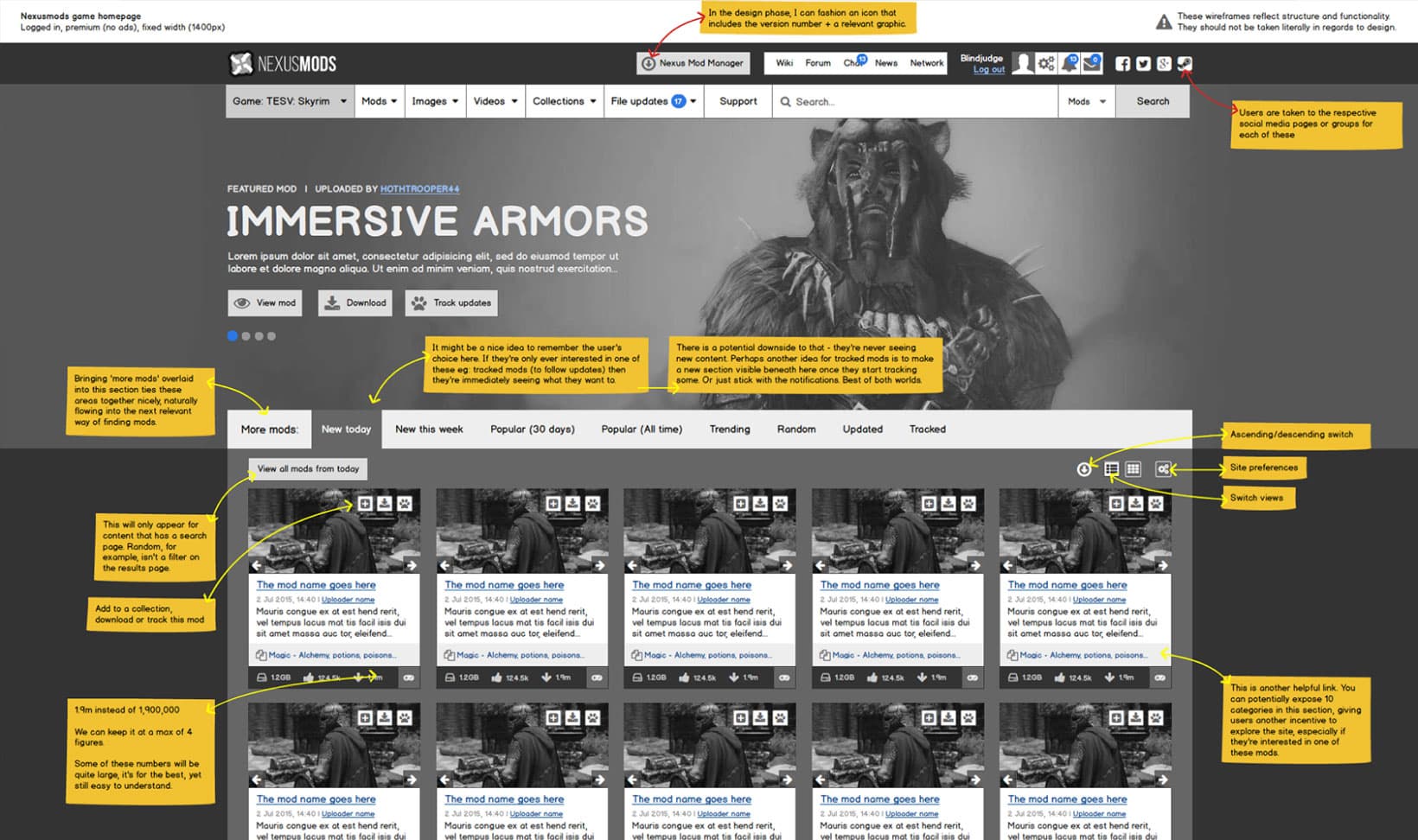
With the research complete and the IA defined, I worked closely with the designer to bring the redesign to life, overseeing the process from initial concepts through to high-fidelity wireframes and final designs.
A 43-page InVision document captured every improvement, developed collaboratively with the Nexus Mods owners and community members. The final redesign was comprehensive. A fully responsive build made the site accessible across desktop, mobile, and tablet for the first time. Every flow was rebuilt: mod submissions, media uploads, commenting, search. Mod pages got a tabbed layout for quicker access to data. Each game's section received its own colour scheme and artwork for instant visual identity.
Users gained personalisation tools to control what content they saw and how. New discovery features (tabs for new, trending, popular, random, and tracked mods) helped surface content that had previously been buried.
Community feedback on the redesign was exceptionally positive.
New Ideas
Collections
Collections was my concept, and it appears in my initial redesign screens. It started life as something simple: let users gather mods into a pot, much like creating a Pinterest board. You'd find mods you liked and pin them to a collection for easy reference and sharing.
After I left, the Nexus Mods team evolved that idea significantly. What began as a bookmarking tool grew into a full curation system where experienced users could share entire tested mod setups. Through the Vortex mod manager, newcomers could import a collection and have every mod fetched and installed automatically from its original page. Authors still received their download credit, and lesser-known mods gained exposure through inclusion in popular collections.
Donation Points
Donation Points was another concept I originated: a way to reward mod authors directly for the value of their work. The founder developed it after I left, and it launched in 2018 with a $100,000 pool for its first year, distributed to mod authors based on unique downloads. Points could be converted to cash, donated to charity, or shared with other authors. It wasn't going to let anyone quit their day job, but it was a tangible acknowledgement that modders' work had real value.
Impact
- 8m to 16m
- approximate membership when I joined in 2015 and when I left in 2017, with around 9.6m when the redesign began
- Nearly 80m
- members today
- 25,000+
- survey responses in a single weekend
When I joined Nexus Mods in 2015, it had around eight million members. By the time the redesign began it had around 9.6 million, and when I left in November 2017 it had around 16 million. Today, the site has evolved further at the hands of other great designers and has nearly 80 million members.
A redesign alone doesn't drive that growth, but it laid the foundation that made everything else possible, turning a desktop-only relic into a modern platform that could scale with its community.
When 25,000 people take time out of their weekend to tell you what they think, the least you can do is pay attention.